


Read on for a guided tour of the Public Reporting Module in SIMAP! See this page for answers to frequently asked questions.
An overview of Public Reporting in SIMAP
Follow these steps to post your data to the Public Reporting Module on SIMAP. Please find more information below on the Public Reporting Module and the steps for entering your data.
- Enter your institution’s data:
- SIMAP users: Enter data into your SIMAP account and mark years as 'complete' on the Data Mgmt tab > Status page
- Enter or import your results on the Account tab > Emissions Reports page
- SIMAP users: Use the ‘Import SIMAP Results’ button
- Non-SIMAP users: Use the ‘Enter Results Manually’ button
- Enter goals on the Account tab > Goals page for display on the Public Reporting platform
- Enter your population and gross square footage on the Account tab
- Publish your data to the Public Reporting Module:
- To publish your emission report, go to the Account tab > Emissions Reports page. Either use the checkboxes to publish your records, or select 'edit' next to a record in the table, scroll to the bottom of the page, check 'publish' and click 'save'
- To publish your goals and institution information, go to the Account tab > Goals page. Check the box for 'Pulish your goals to the Public Reporting Module'
- View the Public Reporting platform:
- Public Reporting home page is a dashboard welcoming visitors to the site
- Emissions Reports page summarizes public records in a table
- Commitments page summarizes public reduction commitments and achievements in a table
- Your institution’s page, which details results for an institution. This is accessible from the Emissions Reports page and Commitments page (if applicable)
A guided tour of each page in the Public Reporting Module:
Public Reporting Home
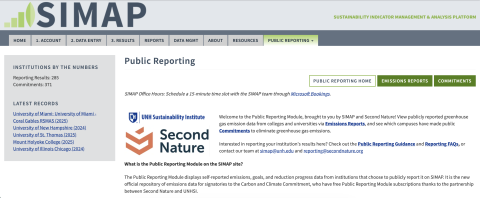
- Welcome to the landing page for the Public Reporting Module! This is what visitors will see first when viewing publicly reporting results on SIMAP.
- There are several key features on this page:
- Sidebar, Institutions by the number:
- This provides a dynamic summary of the total number of institutions publicly reporting and the number of institutions with a reduction commitment.
- Sidebar, Latest records:
- This is a newsfeed with links to the latest public records. Check here for your institution after you submit a public record!
- Maps: Dynamic maps and graphs summarize where institutions with commitments are located.
- Navigation buttons:
- These green buttons are located in the upper right corner of all Public Reporting pages, and help you navigate across the pages.
- Sidebar, Institutions by the number:
Screenshot of the Public Reporting home page
Public Reporting tab > Emissions Reports page
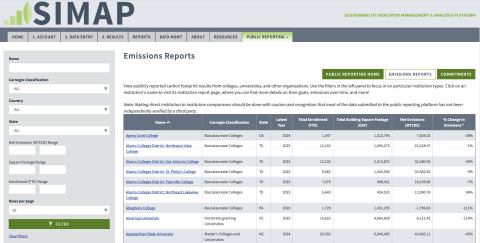
- The Emissions Reports page summarizes all publicly reported institution results.
- The table shows a summary of the publicly reported results. Click an institution’s name to see its institution page.
- The sidebar has filters to help you search the database of publicly reported data sets.
Screenshot of Emissions Reports page
Public Reporting tab > Commitments page
- This page lists all institutions with one of the following reducing commitments:
- Carbon Commitment, Climate Commitment, Resilience Commitment, Race to Zero
- Filter and search using the sidebar
- Please note that this is a comprehensive list of institutions with reduction commitments. Institutions are included here regardless of whether they have submitted a public record.
Screenshot of the Commitments page

Public Reporting tab > Individual institution pages
- See the details of an institution’s publicly reported results on its institution report page. These pages can be accessed several ways:
- The newsfeed on Public Reporting Home for recently published records
- The linked institution name on the Emissions Reports page
- The linked institution name on the Commitments page
- The institution reports contain the following information:
- Reduction commitments (Carbon, Climate, Resilience, Race to Zero)
- Goals (from the Goals page)
- Achievements (e.g., carbon neutrality)
- Text with more information explaining the goals (from the Goals page)
- An external link to more information (from the Goals page)
- Results embedded from GRITS (from the Goals page)
- Interactive graphs summarizing the results
Screenshot of the University of New Hampshire's institution report

How to enter data into the Public Reporting Module:
Account tab > Emissions Reports page
- The Account tab > Emissions Reports page is where you enter your data for the Public Reporting Module. There are two ways to enter “public records”:
- Enter results manually: This feature is available for non-SIMAP users and SIMAP users. To use this feature, click the green button for ‘enter results manually’ and enter your greenhouse gas inventory results.
- Import SIMAP results: This feature is available for SIMAP users only. To make a year of data available for import, go to the Data Mgmt tab > Status page to mark the year(s) as complete. Those years will then be available for import on the Emissions Reports page.
- Once a public record is entered, be sure to review it and publish it. You can do this either by using the checkboxes and bulk operations in the summary table, or by clicking ‘edit’ for an individual public record in the summary table, scroll to the bottom of the page, click the checkbox for ‘publish, and click save. The public record summary table lists which records are published.
Screenshot of the Public Records page

Screenshot for importing your SIMAP results

Screenshot of the results entry form

Account tab > Goals page
This is where you enter goals information you would like to have appear on your public institution report. You can enter the following information for public reporting:
- Specific goals:
- Use the drop-downs to enter any specific goals your institution has. For example, you can enter a carbon neutrality goal and sector-specific goals relative to a base year.
- Enter any information about your goals that you would like to share on the Public Reporting tab:
- Any text you enter in this field will appear on your public institution report.
- Optional URL for display as “More info” link on public reporting institution page:
- Use this to link to an external page that explains your institution’s goals.
- Embed GRITS results:
- Paste code for embedding your GRITS results for display on your institution's page.
Screenshot of the Goals page

Account tab > Population and Physicals Spaces pages
This is where you can enter your population data and gross square footage, which are displayed on the Emissions Reports page. Be sure you have population and physical spaces data entered for all publicly reported years.
Enhancements to Public Reporting
In September 2026, several enhancements to Public Reporting were launched as part of the continued partnership between Second Nature and SIMAP. These updates are intended to make reporting more meaningful and transparent, while also reflecting changes in the greenhouse gas accounting field.
New Fields in Emissions Reports and Data Entry
Added to the top of the Emissions Reports form for Public Reporting:
- “Please share anything that might help contextualize your emissions this year, such as changes in boundaries or methods, exclusions, or external factors such as weather, construction, special events, etc.”
- “Is there anything else you want to share about your progress that isn’t captured in your GHG inventory that you want to share publicly?”
- “Did you use any custom emissions factors in your inventory? If so, please list which sources custom emissions factors were used for and why.”
- “Has your institution made financial contributions to climate justice and/or climate mitigation projects that you are not counting as offsets? If so, please enter the dollar amount of your contribution here.”
Added to the Scope 2 section of the Emissions Reports form for Public Reporting:
- “Please provide any context about your Scope II instruments that isn’t captured by your data entry, or related to why you chose this strategy for engaging with the market. (Ex: If you swap RECs, tell us about it. If you invested in the development of renewable energy beyond your deliverable region to positively impact the grid, say more about that here.)”
Added to the Sinks and Offsets section of the Emissions Reports form for Public Reporting:
- “Please add a link to public documentation of your offsets project(s) (e.g., registry ID link, Offsets Lab website, campus webpage).”
- Please describe your offset purchases (i.e., project type, organization, cost per tonne, additional links, etc.).
- “Please add a link to public documentation of your offsets project(s) (e.g., registry ID link, Offsets Lab website, campus webpage).” added to Offsets Data Entry.
Added to the Mitigation section of the Emissions Reports form for Public Reporting and the Renewable Energy section of data entry.
- Virtual Power Purchase Agreement and Virtual Power Purchase Agreement Verification options.
Updates in Public Reporting
- Updates 1-7 of this list will show up in the new Narrative/Context page of an institution's Public Reporting profile. The link will only be shown if an institution has entered information for one of these fields. There will be an accordion displaying each year that has data entered that will expand to show the narrative and additional context.
- The non-additional sequestration and biogenic colors/patterns have been changed in the Net footprint and Gross footprint graphs. These changes are consistent throughout Public Reporting and the calculation module.
- Scope 1 and Scope 2 percent change in emissions have been added to the 'Change in Emissions' section of institutions' main pages. The combined change Scope 1 and Scope 2 is still listed.
- Totals, Scopes, and Categories emissions data tables have been updated so that each year has its own column, with the categories having their own row, whereas before each category had a column and each year had its own row. This allows for easier year-over-year comparison. This update was added in May 2026.
- The Carbon Neutral filter and data column has been removed from the Emissions Reports section of Public Reporting
New to Publishing Alerts
- You will receive a blue informational alert when there are:
- Changes in emissions for a category greater than 20% compared to the nearest published year.
- New category(ies)
- Missing category(ies)
- You will receive a red error alert when no data has been entered in Physical Spaces and/or Populations sections of Normalizations for the year being reported. The inventory will not be published to Public Reporting until that data has been added.
- You will receive a yellow warning alert when a category required by the Second Nature commitment(s) is 0 and/or waste data has not been entered.
- “The following required fields should be greater than 0, please check for accuracy.”
- "Second Nature will now require 'Waste generated in operations.' The reporting requirement will go into effect for CY2029/FY2029."
Updates to the Goals Page
- The Goals Page has been updated to include the following text and goal option:
- "Please enter your emissions reduction goals."
- "Second Nature requires carbon neutrality and/or decarbonization targets, and additional specific goals related to stationary combustion and purchased electricity emissions. You may include additional goals for other emissions as desired."
- "*** Second Nature recommends decarbonization targets for the sector as follows: 90% by 2045 or 85% by 2050."
- The option to enter a decarbonization goal has been added.
For examples of these updates and alerts, review the webinar slides from the Overview of SIMAP Enhancements and Q&A (presented 11/4/2026).
Please contact the SIMAP team (simap@unh.edu) or the Second Nature team (reporting@secondnature.org) with any questions.