

How is the Univeristy of New Hampshire (UNH) associated with SIMAP?
The UNH Sustainability Institute (UNHSI) is the managing agency for SIMAP. The SIMAP Team at UNHSI strives to incorporate the best available science into SIMAP’s continuous development to standardize the accounting process informed by the GHG Protocol methodologies and supplemented with knowledge from the Intergovernmental Panel on Climate Change, Environmental Protection Agency, and other organizations.
Does UNH have a climate action plan (CAP)? What is its goal? Is it on track?
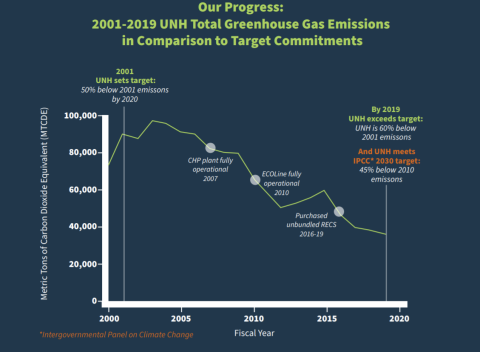
In 2006, UNH signed onto the Climate Commitment requiring UNH to track and publicly report its carbon footprint and maintain an up-to-date Climate Action Plan. Faculty, staff, and students at UNH serve on the Energy Task Force (ETF) – created in 2005 to help guide reductions in energy use, energy costs, and greenhouse gas emissions on campus. The ETF stewards UNH’s climate action plan, called WildCAP (cleverly named to fit the Wildcat mascot!). UNH exceeded original targets with a 60% reduction below 2001 levels by 2019. UNH also met the IPCC 2030 target of a 45% reduction below 2010 emissions. An updated WildCAP, released in 2021, established new goals including a 75% reduction of 2010 scope 1 and 2 emissions by 2030 and net-zero carbon emissions as rapidly as possible (no later than 2050). UNH also aims to refine their undertsanding of upstream and downstream emissions and expand scope 3 accounting.
Read a summary of WildCAP 2021 here, or the full climate action plan!
What is the relationship between Second Nature and UNH?
Stay tuned for more updates on the Second Nature - SIMAP partnership!